A fine finish depends on the preparation beneath it
Silicone Rendering Crewe | Compare the Complete Finish System
Silicone rendering is usually discussed in terms of its final colour and fine texture. The more important first question is what supports that surface. A thin decorative finish needs the correct prepared background and system build-up. The proposal should explain those layers clearly, whether the work is on a new extension, an existing rendered house or an insulated façade. That makes the finish easier to compare with other options on a like-for-like basis.

On this page
Find out what the quotation means by silicone rendering
The phrase can be used loosely, so identify the named products and the work included. A complete new render system differs from a decorative coating over a retained covering. Both may involve a silicone-based finish, but their preparation and purpose are not the same. The specification should state the background, required treatment, base layers and final surface. If it only names the finish and a colour, it leaves unanswered questions about the work that determines whether that surface is suitable.
Where the existing covering is being retained, its condition and compatibility need assessment. Weak paint, detached render or an unsuitable previous treatment cannot simply be hidden beneath a new face. If a colour change is the main objective, compare the scope with render respray. If the wall needs extensive repairs, those should be described separately. The finished photograph may look similar in each case, but the operations behind it can be substantially different.
- Sound background A background accepted by the specified system. Keeping old render requires a system-specific assessment of its bond and condition.
- Beads Corner, stop and base beads set the edges and straight lines.
- Basecoat with mesh Glass-fibre mesh embedded in the basecoat resists cracking.
- Primer Where the system requires it, tinted towards the finish colour.
- Silicone finish A thin, through-coloured, water-repellent coat that forms the texture.
Wall on the left, finish on the right. Not to scale: coats, thicknesses and primers follow the chosen manufacturer’s system and the condition of the wall.
Decide what level of texture you want to see
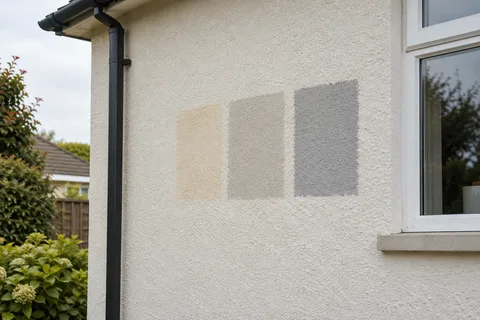
A fine-grained surface can provide a restrained appearance, while a more visible grain has a different effect over a broad elevation. Samples should be large enough to show the texture and should use the intended build-up. View them in ordinary daylight beside the materials that remain on the building. A small colour chip helps narrow the selection but cannot demonstrate the applied surface. The same shade can read differently when the grain and lighting change.
Flatness is a separate issue. If the background is uneven, the specification needs to identify how that will be addressed within the appropriate build-up. The decorative layer should not be expected to correct the shape of the wall. A sample over an unrepresentative smooth board can give a misleading impression of what the actual elevation will look like. Agree the intended standard with reference to the wall and the preparation proposed, rather than approve a finish detached from the conditions it will meet.
| Element | What to compare |
|---|---|
| Retained background | Condition and suitability of the layers left in place |
| Preparation | Cleaning, removal, repair and system-specific treatment |
| Base build-up | The layers supporting the decorative surface |
| Finish | Named product, grain and colour |
| Details | Openings, edges, joints and fittings |
| Care | Cleaning, repairs and later alterations |
Pay attention to changes in construction
A recently infilled opening or an extension can introduce different masonry within one elevation. The selected system's guidance and the construction design should address those changes. A continuous colour does not mean the background behaves as one uniform material. The specification should identify appropriate preparation and junctions rather than assume that reinforcement alone resolves every difference. Our wall-rendering page explains how to define an altered elevation, including the edges around openings and the connection to retained work.
The position of sills, roof edges and wall-base details also matters. New layers can change the effective projection of a feature or the depth of a reveal. Establish the intended finished line and identify associated alterations before application. Pipes, vents and service terminals need a suitable arrangement, with specialist work assigned to the appropriate people. A fine surface looks most convincing when these boundaries are deliberate; neat application across the middle cannot compensate for an unresolved edge.
Keep insulation separate in the scope
A silicone finish can belong to an external wall insulation system, but it does not establish that insulation is included. The complete system needs a design for its thickness, fixings and interfaces. A render-only proposal has different requirements. When comparing quotes, identify which construction each is offering before considering the visual result. Two examples with similar colour and grain may represent quite different work beneath the surface.
If insulation is proposed, plan for future fittings and repairs as well as the immediate installation. The completed face should not be treated as ordinary solid render for every attachment or cleaning operation. Retain the system information and follow the relevant guidance. Where the project is render-only, the product references are still useful for later repair. Knowing what is on the wall is more reliable than selecting a future treatment because its marketing description sounds similar.
Give the application a workable programme
Delivery, storage, access and weather protection need to fit the selected system. Materials should be handled according to their requirements, and application should take place in suitable conditions. The programme needs room for preparation and the appropriate intervals between stages. A quick final application does not mean the whole project is a one-day operation. Other trades should complete the relevant window, roof or fitting work at the right point so the new finish is not immediately cut or patched.
For an occupied house, identify entrances and routes affected by the work and explain any temporary restrictions. Protect adjacent glass, paving and neighbouring surfaces appropriately. These practical arrangements are part of achieving a clean result, especially on a tight site. The house-rendering guide connects them across several elevations, while a limited wall project can use a smaller but equally clear sequence. The important thing is that the site allows the specified method to be carried out properly.
Compare alternatives and plan the next maintenance step
Monocouche provides a different mineral surface character and may be an alternative on a suitable background. Compare the entire proposed systems, including appearance, preparation and upkeep. At completion, inspect the sample standard, boundaries and reinstated fittings, then keep the product and colour details. The Crewe homepage links the related options. Silicone finishes can suit a range of well-specified projects, but their role is most useful when the layers beneath and the details around them are understood as part of the same job.
Common questions
Is silicone rendering the same as exterior masonry paint?
No single description covers both. A thin-coat render finish within a specified build-up and a decorative paint coating can involve different materials and preparation. The quotation should identify the actual product and method rather than rely on a broad marketing term.
Can I choose a finer texture to hide an uneven wall?
A finer texture does not flatten the background and may make some irregularities more apparent. Discuss the required preparation and view a representative sample. The desired appearance should be achievable through the specified build-up, not assumed to come from the final coat alone.
See housing and planning information for Crewe and nearby places, including the source and geography behind each figure.