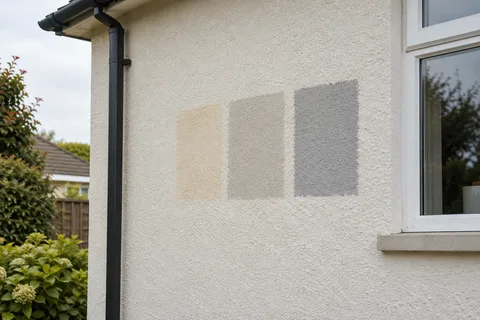
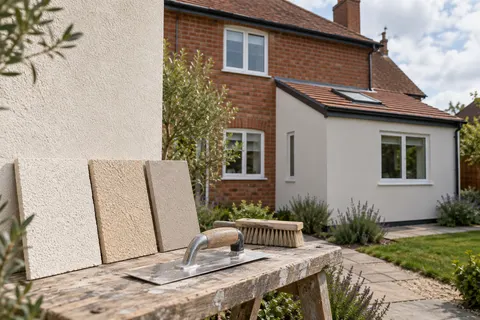
A colour swatch cannot show the whole surface
Smooth, Fine-Grained or Scraped: Judge a Full-Size Sample
Render choices are often presented as rows of colour swatches, but texture can change the appearance just as strongly. A fine-grained coating, a scraped mineral finish and a traditionally worked surface catch light differently. Their suitability also depends on the wall and the complete system. A representative sample is a useful way to connect technical selection with visual preference. It should show the proposed material on an appropriate build-up, at a scale where the intended grain can actually be judged.

On this page
Separate texture from flatness
Texture is the character of the surface; flatness concerns the shape of the background beneath it. A fine finish does not automatically make an uneven wall flat, and a rougher grain does not make poor preparation acceptable. The specification needs to establish the background and any appropriate levelling work before the final appearance is approved. Otherwise a sample on a perfectly flat display board can suggest a result that the proposed work on the actual wall does not deliver.
Describe what you mean by smooth. You may want a restrained grain visible only close up, a genuinely different type of finish or simply fewer obvious patches than the existing wall. Those are different expectations. Compare them with the contractor and the relevant system options before choosing a shade. The silicone guide explains the relationship between a thin decorative finish and its supporting layers, while monocouche offers a different mineral surface character that should be judged on its own terms.
Make the sample represent the intended system
Identify the product or materials, the preparation and the application method the sample demonstrates. If a particular background or repaired area is likely to influence the result, a representative sample should account for it where appropriate. A convenient board may be useful for initial selection but not sufficient to settle every aspect of the completed wall. Agree the purpose of the sample so it is clear whether it demonstrates colour only, texture, a junction detail or the whole proposed build-up.
The sample also needs a practical scale. A tiny patch can show individual grains but not how they combine across an elevation. A larger area can reveal the surface's visual character and how it meets an edge or opening. The suitable arrangement depends on the project and any requirements affecting the building. On traditional or designated fabric, sample location and application may need prior agreement. Our lime page explains why the material and retained fabric should lead that decision rather than a desire to test products indiscriminately on the wall.
| Feature | What to observe | What not to assume |
|---|---|---|
| Grain | Its scale and visibility across the sample | A colour name describes the texture |
| Light | Appearance in shade and ordinary daylight | One photograph represents every condition |
| Background | How preparation affects the face | The final layer will flatten the wall |
| Edges | The meeting with beads and retained features | The main panel sample settles every junction |
| Repair appearance | The result over a representative patched area | Opaque colour makes physical differences disappear |
View it beside the materials that will stay
Roof tiles, window frames, exposed brick and paving influence how a render colour and texture are perceived. A sample viewed alone in a showroom may look different beside the house. Place or view the reference in the actual setting where practical, with enough context to judge the relationship. Consider the broad approach to the building as well as close inspection. A texture may look attractive at arm's length but dominate a large front elevation more than expected.
Light also varies between faces. A shaded side wall and a bright front can make the same material appear different without either being wrong. View the sample under representative conditions rather than make the decision from one dramatic photograph. The aim is an informed preference, not a promise that the surface will have one fixed appearance throughout the day. Where exact matching to retained weathered render is important, discuss the practical limits and consider whether a deliberate boundary provides a clearer visual result.


Include the awkward details in the decision
A broad sample of the main surface may not show how the material looks around a narrow reveal, corner or retained surround. If those details are important to the design, include them in the reference or provide a clear drawing. The thickness and edge treatment should preserve suitable projections and the intended profile. A change chosen solely for a smooth-looking face can alter the proportions of a sill or band if the supporting build-up is not considered.
For an altered elevation, the wall-rendering guide helps identify the relevant boundaries. If several walls are changing, the house-rendering page connects the samples with the overall scheme. Different backgrounds may justify different systems even when the colours are coordinated. In that situation, view the proposed finishes together and record which belongs where. A visual relationship can be intentional without requiring identical materials across constructions that have different technical needs.
Use a repaired area to test a recolouring expectation
If the project involves respraying existing render, the sample should help show what the coating can and cannot change. A repair with a different grain or level may remain visible after both areas share the same colour. It is better to see that before a full elevation is coated than discover it at completion. The repair method and finish scope can then be reconsidered if the intended appearance requires more than decoration alone.
This does not mean every visible patch requires complete replacement. A compatible repair may be the proportionate choice, with its presence accepted as part of a maintained building. The important thing is a clear expectation. A sample can support that discussion by showing a representative result, while the specification explains the materials and preparation. It should not become a device for promising an invisible repair under every light condition or for disguising a technically unsuitable treatment behind an attractive shade.
Record the approval so the reference remains useful
Label the sample with its material, colour, texture and relevant method. Note the date and the area of the building it represents. If the specification changes, confirm whether the sample still applies or whether a new reference is needed. Keep a photograph with context and retain the appropriate product information. A sample without an identity can become confusing later, especially when several options were considered and only one was approved.
The final inspection should refer to the agreed standard and sensible viewing conditions, alongside the technical scope. Colour and texture are important, but they do not establish the condition of concealed layers or the correctness of every interface. Those require their own appropriate checks during the work. The Crewe homepage links the services behind the finishes. A good sample helps turn a vague preference into a visible, recorded choice, while leaving the underlying system and the actual wall at the centre of the specification.
Change one visual variable at a time when comparing options
If two samples differ in both colour and grain, it can be difficult to tell which difference drives your preference. A useful comparison may hold the colour broadly consistent while examining texture, then consider the final shade within the suitable system. This is a design aid rather than a requirement to produce an excessive number of panels. Select the comparisons that answer the real uncertainty. Once an option is chosen, view it with the retained materials and record the complete reference. That keeps a preference for one sample from being transferred accidentally to another product that shares its colour name but has a noticeably different surface character.
Common questions
Can a small printed colour chart be enough for a final decision?
It can narrow the choice, but it does not show the applied grain, background or full exterior setting. A representative sample is more useful when texture, matching or a large elevation is important. The extent of sampling should suit the project and any relevant requirements.
Does a finer finish always look more expensive or better?
That is a design preference, not a technical ranking. The building, retained materials and desired appearance determine what works visually, while the background determines which systems are suitable. Compare representative samples rather than assume the smallest grain is automatically the best choice.
See housing and planning information for Crewe and nearby places, including the source and geography behind each figure.